
How to Choose Montessori Toys That Match Your Child’s Developmental Needs
Montessori toys help children learn through hands-on play, repetition, and independent discovery. Each toy usually focuses on one skill, such as sorting, stacking, counting, matching, or problem-solving.
Simple designs allow your child to focus on the activity without flashing lights, loud sounds, or distracting features.
Choosing suitable Montessori-inspired materials can support concentration, coordination, confidence, and practical abilities. Your child can explore each activity at a comfortable pace, repeat it as needed, and learn from mistakes without constant adult direction.
What Are Montessori Toys?
Montessori toys are learning materials inspired by the educational principles developed by Dr. Maria Montessori. They encourage children to use their senses, make decisions, and complete tasks independently.
These toys often feature:
- Natural materials such as wood, cotton, or metal
- Simple shapes and neutral or pleasant colors
- Activities focused on a single learning objective
- Child-friendly sizes and designs
- Self-correcting features that help children notice mistakes
- Open-ended activities with several possible outcomes
A wooden shape sorter, for example, teaches shape recognition and hand-eye coordination. Your child can quickly see when a piece does not fit and try another opening without needing immediate correction.
Benefits of Montessori Toys for Children
They Encourage Independent Play
Montessori-style activities give your child an opportunity to work without constant instructions. Completing a puzzle, stacking rings, or matching cards can build confidence and patience.
Independent play does not mean leaving your child unattended. You can stay nearby while allowing enough time for experimentation and discovery.
They Develop Fine Motor Skills
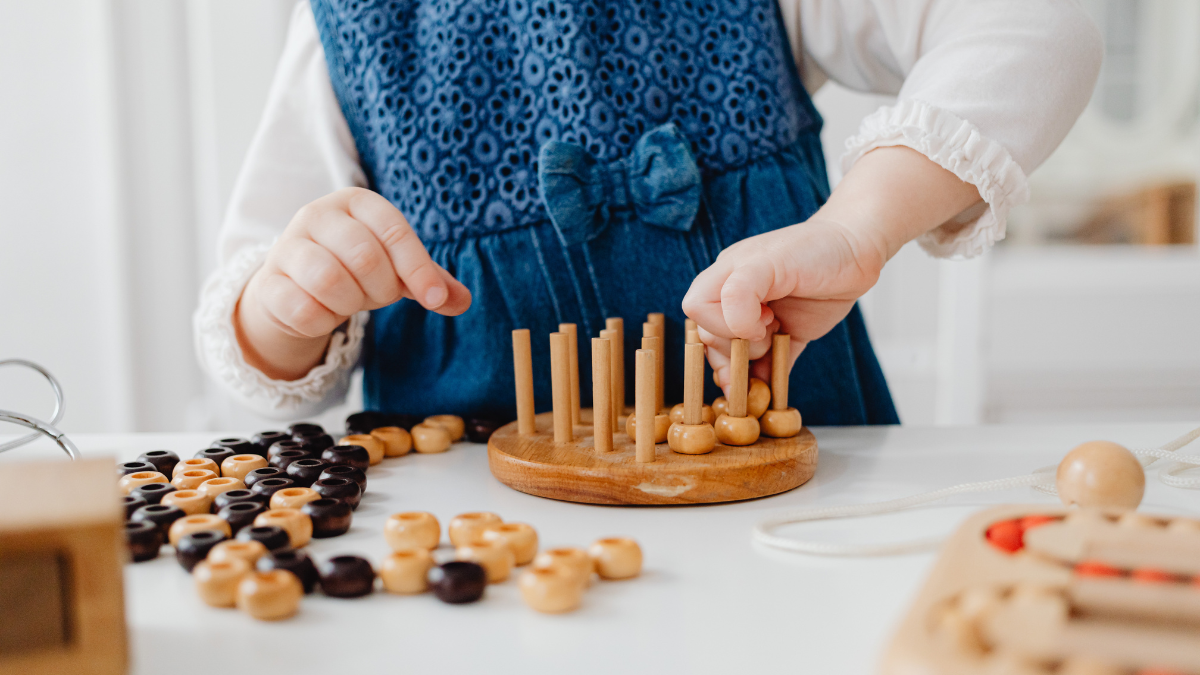
Many Montessori toys require controlled hand movements. Peg boards, threading activities, stacking toys, and wooden puzzles can strengthen the small muscles used for writing, dressing, and using utensils.
Repeated practice may improve grip, coordination, and finger control.
They Support Problem-Solving
Sorting objects, building structures, and fitting pieces together encourage logical thinking. Your child learns to test ideas, notice patterns, and adjust an approach when something does not work.
These early problem-solving experiences can support later learning in mathematics, reading, and everyday tasks.
They Improve Focus
Simple toys reduce unnecessary distractions. Instead of responding to automatic sounds or lights, your child must interact with the material directly.
An activity with a clear purpose can hold attention and encourage careful observation. Over time, this may help your child stay focused during longer tasks.
They Promote Sensory Learning
Young children learn by touching, seeing, hearing, and moving objects. Texture boards, sound cylinders, color tablets, and sensory balls introduce differences in texture, weight, size, color, and sound.
Sensory play helps children organize information and understand their surroundings.
Best Montessori Toys by Age
Montessori Toys for Babies
Babies benefit from safe toys that support grasping, tracking, and sensory exploration. Suitable options include:
- Wooden grasping rings
- Soft sensory balls
- Object permanence boxes
- Baby-safe mirrors
- Simple rattles
- Rolling drums
Choose lightweight materials with smooth surfaces and no detachable small parts. Always follow the manufacturer’s age and safety guidance.
Montessori Toys for One-Year-Olds
At this age, children often enjoy putting objects into containers, opening compartments, and copying simple actions.
Helpful choices include:
- Coin boxes
- Stacking rings
- Large knob puzzles
- Push-and-pull toys
- Nesting cups
- Simple shape sorters
These activities support coordination, spatial awareness, and early problem-solving.
Montessori Toys for Two-Year-Olds
Two-year-olds may show increased interest in sorting, matching, building, and pretend play. Suitable toys include:
- Color-matching sets
- Wooden blocks
- Threading beads
- Peg boards
- Practical-life kits
- Animal matching cards
You can also introduce child-sized cleaning tools, dressing frames, and kitchen accessories designed for supervised use.
Montessori Toys for Three-Year-Olds and Older
Preschool-aged children may enjoy activities involving numbers, letters, patterns, and detailed hand movements.
Popular choices include:
- Number boards
- Letter tracing boards
- Counting materials
- Pattern blocks
- Wooden construction sets
- Beginner science activities
- Geography puzzles
Select activities that challenge your child without causing ongoing frustration.
How to Choose the Right Montessori Toys
Match the Toy to Your Child’s Ability
Age labels provide general guidance, yet your child’s current skills and interests matter. Choose an activity that is slightly challenging while remaining achievable.
A toy that feels too easy may quickly lose attention. An overly difficult activity may cause frustration.
Look for a Clear Purpose
A well-designed Montessori toy usually targets a specific ability. Before buying, ask what your child will practise while using it.
The activity might teach:
- Sorting by size or color
- Recognizing shapes
- Counting objects
- Strengthening hand control
- Following a sequence
- Solving basic problems
Avoid toys packed with unrelated functions, especially when those features distract from the main activity.
Prioritize Safety and Durability
Check that wooden toys have smooth edges, secure parts, and child-safe finishes. Inspect each item regularly for cracks, loose pieces, splinters, or damaged paint.
Small parts can present a choking risk for children under three. Review product warnings carefully and supervise play when needed.
Choose Quality Over Quantity
A small selection of purposeful toys can provide plenty of learning opportunities. Too many visible choices may make it difficult for your child to settle on one activity.
You can rotate toys every few weeks based on interest and developmental needs. Store unused items away, then reintroduce them later.
How to Set Up a Montessori-Inspired Play Area
Place a few activities on a low shelf where your child can see and reach them. Arrange each toy neatly in a basket or tray. This setup makes selection and cleanup easier.
Keep the area organized and avoid filling every available space. Each material should have a designated place. You can demonstrate how to use a new activity slowly, then let your child try independently.
Observe how your child plays before offering help. A short pause gives your child time to think and attempt a solution.
Common Mistakes When Buying Montessori Toys
Some products use the Montessori label mainly for marketing. A wooden toy does not automatically follow Montessori principles.
Watch for these common buying mistakes:
- Purchasing toys only because they are made from wood
- Selecting activities that are too advanced
- Buying too many toys at once
- Choosing toys with excessive lights or sounds
- Correcting every mistake immediately
- Ignoring product safety information
- Expecting one toy to teach several unrelated skills
Focus on purposeful design, active participation, and suitability for your child’s present development.
Can Regular Household Items Support Montessori Learning?
Many everyday objects can provide valuable practical experience. Under close supervision, your child can practise transferring dry pasta with a spoon, pairing socks, wiping a table, watering plants, or placing safe objects into containers.
These activities build coordination, responsibility, and independence. Use child-sized tools whenever possible and remove sharp, breakable, or hazardous items.
Helping Your Child Learn Through Purposeful Play
Montessori toys can support independent thinking, concentration, motor development, and early academic skills. The best choice matches your child’s age, interests, and current abilities while encouraging active participation.
Start with a small selection of simple activities. Keep the play area organized, demonstrate each task calmly, and give your child enough time to practise. Purposeful materials and patient guidance can turn daily play into meaningful learning experiences.